Overview
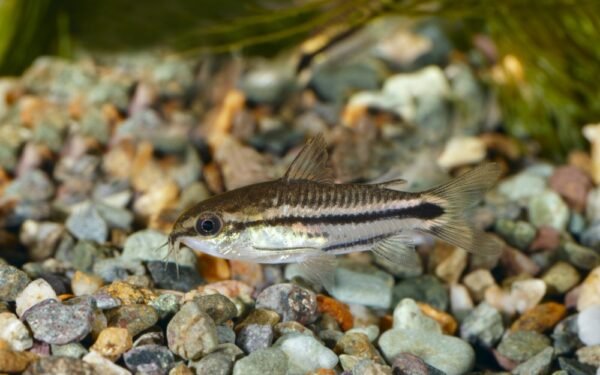
The Black Ruby Barb is one of Sri Lanka’s most visually rewarding endemics. Found naturally in shaded, slow-to-moderate hill streams in the Kelani and Nilwala river basins — areas with dense riparian canopy, leaf litter, and soft, slightly acidic water — males develop an extraordinary deep crimson flush across the body when in peak condition or during spawning activity. Females stay a more subdued olive-gold with the same three bold black bars that give the species its common name. Despite their small size, these are active, confident fish that do best in numbers. A single male in a sparse setup will either hide constantly or fixate aggression on a single target; a proper shoal of eight or more distributes that energy naturally and produces the kind of mid-water display that makes the species worth keeping.
Water Parameters
| Temperature | 20–26°C |
| pH | 6.0–7.5 |
| Hardness | 2–12 dGH |
| Ammonia / Nitrite | 0 ppm |
| Nitrate | <20 ppm |
| Flow | Gentle to moderate |
In Sri Lanka’s hill-stream habitats these fish experience cooler temperatures than most tropicals — water in the upper Kelani basin can sit around 20–22°C in the cooler months. Avoid keeping them above 27°C long-term; chronic warmth shortens lifespan and fades male coloration. Soft, slightly tannin-stained water brings out the best ruby coloration on males.
Tank Setup
A 60-litre tank is a workable minimum for a group of eight, but a 90-litre setup gives far better results — more swimming room reduces the low-level sparring that males engage in at close quarters. Use a dark, fine substrate such as river sand with scattered leaf litter (Indian almond or jackfruit leaves work well) to replicate the forest-stream floor. Dense planting along the sides and back, with open water in the centre, suits their natural behavior. Floating plants that diffuse light — water sprite, frogbit — are especially useful because this species is found under heavy canopy in the wild and behaves more boldly under lower, dappled light. Provide some driftwood for tannin release and structure. Filtration should produce a gentle current; a sponge filter or spray bar turned toward the glass keeps flow mild while maintaining oxygenation.
Diet & Feeding
Black Ruby Barbs are unfussy omnivores in practice. A quality small-pellet or micro-granule staple covers their base nutrition. Supplement regularly with frozen or live daphnia, baby brine shrimp, and micro worms — live foods in particular trigger visible color intensification in males within a few days. They will graze on soft algae and biofilm, and will occasionally nibble at very fine-leaved plants, though robust planting choices largely prevent this from becoming a problem. Feed small amounts twice daily and avoid overfeeding; like most barbs they are opportunistic and will overeat if given the chance.
Breeding Notes
Breeding Black Ruby Barbs is straightforward. Condition a pair or a small group (two males, three females) in a separate 30–40 litre tank with fine-leaved plants such as Java moss or spawning mops, slightly acidic soft water, and temperature nudged up to 24–26°C. Males will display intensely — their bodies go near-black across the lower half with a vivid crimson crown — and scatter eggs among the plants. Remove adults immediately after spawning as they will consume eggs. Eggs hatch in approximately 24–36 hours; fry are free-swimming by day three or four and accept infusoria or commercial fry foods initially, graduating to baby brine shrimp nauplii within a week.
Tank Mates
Keep Black Ruby Barbs with similarly active, robust species that won’t be stressed by the mid-level movement and occasional male-to-male posturing. Other small cyprinids from similar South/Southeast Asian soft-water habitats work well — Ember Tetras and Harlequin Rasboras are reliable choices that occupy similar water layers without conflict. Bottom dwellers like Corydoras sterbai or Khuli Loaches share the leaf-litter zone without competing. Dwarf Gourami can coexist provided the tank is large enough that the gourami isn’t constantly harassed. Avoid long-finned fish such as bettas or fancy guppies — the barbs will fin-nip reliably. Cherry Shrimp colonies may be picked at, especially juveniles; Amano Shrimp are large enough to hold their own and are generally left alone.
Compatible Tank Mates
Species that pair well with Black Ruby Barb — linked where we've already covered them.
- Ember Tetra Hyphessobrycon amandae
- Harlequin Rasbora Trigonostigma heteromorpha
- Khuli Loach Pangio kuhlii
- Corydoras sterbai Corydoras sterbai
- Amano Shrimp Caridina multidentata
- Dwarf Gourami Trichogaster lalius
- Celestial Pearl Danio Danio margaritatus
Similar Fishes
Other species with comparable care, size, or role in a planted tank.
- Cherry Barb Puntius titteya
- Odessa Barb Pethia padamya
- Rosy Barb Pethia conchonius
- Golden Barb Barbodes semifasciolatus
- Ticto Barb Pethia ticto
- Checkered Barb Oliotius oligolepis
- Five-banded Barb Desmopuntius pentazona
Compatible Plants
Plants that work well in a tank stocked with Black Ruby Barb.
- Java Moss Taxiphyllum barbieri
- Java Fern Microsorum pteropus
- Water Sprite Ceratopteris thalictroides
- Cryptocoryne wendtii Cryptocoryne wendtii
- Anubias Barteri Anubias barteri
- Frogbit Limnobium laevigatum
- Bolbitis Fern Bolbitis heudelotii
Recommended Hardscape
Stone, wood, and substrate that suit Black Ruby Barb's natural habitat and behavior.
- Spider Wood Spider Wood
- Indian Almond Leaves Indian Almond Leaves
- River Sand River Sand
- Seiryu Stone Seiryu Stone
- Mopani Wood Mopani Wood