Overview
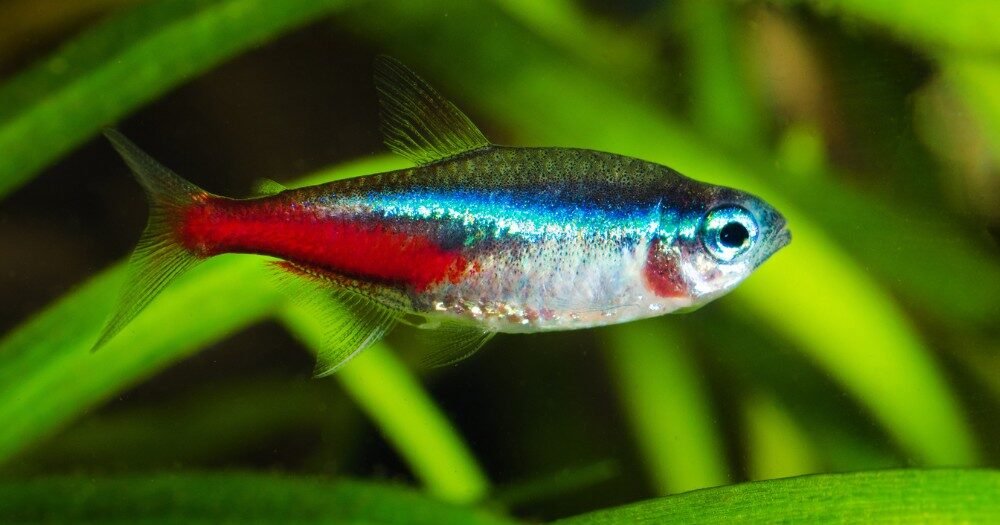
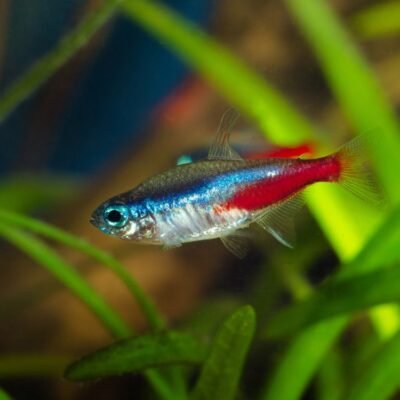
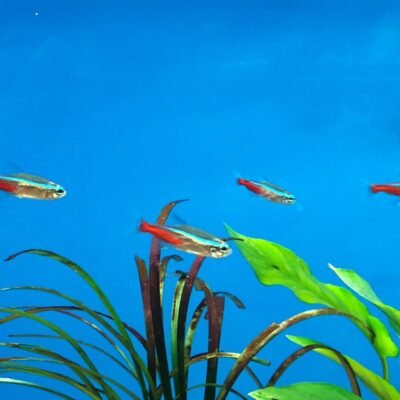
Paracheirodon innesi originates from the upper Amazon basin — specifically the blackwater and clearwater tributaries of Peru, Colombia, and Brazil. In the wild it inhabits tea-coloured, acidic streams heavily shaded by forest canopy, where conductivity can be under 50 µS/cm. That context matters enormously in the aquarium. Most of the neons sold in Sri Lanka are commercially bred in Southeast Asia under moderately soft, near-neutral water, which makes them more adaptable than wild-caught stock, but they still show their best colour and longest lifespans when kept on the softer, slightly acidic end of the spectrum. A healthy, well-maintained group in a planted blackwater tank is genuinely one of the most striking sights in the hobby — the electric blue lateral stripe and carmine-red tail look almost painted on.
Water Parameters
This species is the one most commonly killed by sudden pH swings and hard municipal water. Match parameters before adding fish, not after.
| Temperature | 22–26°C |
| pH | 5.5–7.0 |
| Hardness | 1–10 dGH |
| TDS | 50–200 ppm ideal |
| Ammonia / Nitrite | 0 ppm |
| Nitrate | <20 ppm |
Colombo and Kandy tap water typically runs 6.8–7.4 pH with moderate hardness — usable, but buffering capacity is low and pH can crash in a densely planted tank. If your source water exceeds 150 ppm TDS, consider blending with RO water at roughly 1:1 to bring parameters into range. Neons are disproportionately vulnerable to Neon Tetra Disease (Pleistophora hyphessobryconis) when stressed by poor water quality; there is no cure, so prevention is everything.
Tank Setup
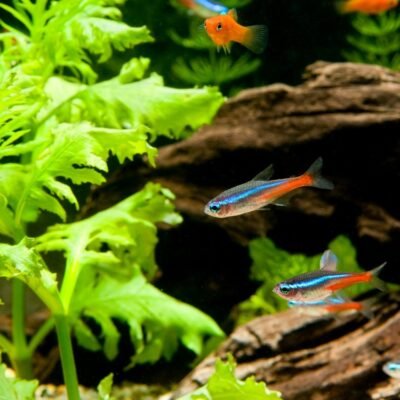
A 60-litre tank is the practical minimum for a group of ten, though a longer, shallower footprint — 75cm x 35cm, for instance — works better than a tall column. These fish occupy the middle column and feel most secure with some visual cover. A classic approach that works well locally is a simple Iwagumi or Dutch-inspired layout with fine-leaved stem plants like Rotala rotundifolia, a dark substrate (black sand reads beautifully against the neon stripe), and Indian almond leaf litter on the bottom to tannin the water gently. Strong flow is not required — a gentle turnover of 4–5× tank volume per hour is sufficient. Keep lighting moderate; high-intensity LED rigs without adequate plant cover will wash out the colours and stress the fish.
Diet & Feeding
In the wild, neons pick off small invertebrates, zooplankton, and fallen organic matter. In the aquarium they are unfussy but do best on varied, protein-rich micro foods. A quality micro-pellet or nano flake as the staple, supplemented three to four times a week with frozen cyclops, micro bloodworms, or baby brine shrimp, keeps them in peak condition. Feed small amounts twice daily — anything that sinks uneaten past 90 seconds is too much. Neons have small mouths; anything larger than 1mm particle size is often ignored or spat out.
Breeding Notes
Breeding neons is achievable but genuinely fiddly. A separate 20-30L breeding tank is essential — spawning over java moss or a fine mesh to protect eggs from the adults. Water needs to be very soft (under 2 dGH), slightly acidic (pH 5.5–6.5), and the tank should be nearly dark during spawning and egg incubation, as the eggs are extremely light-sensitive. Condition a pair separately on live or frozen foods for one to two weeks before moving them to the breeding tank at lights-out. Eggs hatch in roughly 24 hours; fry are free-swimming by day four and require infusoria or commercial first foods (Sera Micron, for example) before graduating to baby brine shrimp at around one week. Egg fungus is a common failure point — a single drop of methylene blue in the breeding tank helps. Don’t expect commercial hatchery results on your first attempt.
Tank Mates
Neons are small and slow-moving, so tank mate selection matters more than people admit. Ideal companions are other small South American characins (ember tetras, rummy-nose tetras), small peaceful corydoras, otocinclus, and dwarf rasboras of similar size. Avoid anything nippy — tiger barbs and serpae tetras will shred fins. Bettas are a risk; some individuals ignore neons entirely, others hunt them. Large cichlids, gourami species in cramped quarters, and anything predatory enough to swallow a 3cm fish are obvious exclusions. A species-only setup with a large, tight-schooling group in a well-planted tank is arguably the most impressive way to keep them.